- MSK(Busam 等)回顾送会诊的「原发灶不明转移性黑色素瘤(MUP)」并做 MSK-IMPACT 的病例,19 例符合原发性真皮黑色素瘤(PDM)标准——真皮或皮下起源、无表皮受累,易被误判为皮肤转移(CMM),影响分期。
- PDM 基因组改变总负荷较低,常见改变 TERT 79%、TP53 37%、NRAS 37%、APC 32%;较 CMM NRAS、TP53 突变更多、BRAF 改变更少;独有 ZFHX3、FGFR3、NTRK3、SMARCA4 突变。
- PDM 总生存优于 CMM(随访 8.9 年),也优于常规原发性黑色素瘤;支持将其作为独立实体,用于准确分期与治疗决策。
收录范围:PubMed 英文摘要及中文翻译(abstract-only),另附 Human Pathology 官方 X 帖所附原文图版。原文为订阅制(Unpaywall:closed),ScienceDirect 对本站返回 Cloudflare 验证,未采集全文、表格与图注。
摘要
原发性真皮黑色素瘤(PDM)是一种罕见的黑色素瘤类型,起源于真皮或皮下而无表皮受累。由于可能与皮肤转移性黑色素瘤(CMM)混淆,PDM 给准确分期带来重大诊断挑战。为评估 PDM 可能存在的误分类,我们回顾性复查了送会诊、并同时采用 MSK-IMPACT 平台进行分子谱分析的原发灶不明转移性黑色素瘤(MUP)病例。共识别出 19 例符合 PDM 标准的病例,其基因组改变总负荷较低,且总生存优于 CMM,支持将其重新归类为原发性肿瘤而非转移性病变。PDM 中最常发生改变的基因为 TERT(79%)、TP53(37%)、NRAS(37%)和 APC(32%)。PDM 中独有的突变包括 ZFHX3、FGFR3、NTRK3 和 SMARCA4。与 CMM 相比,PDM 呈现独特的突变谱,表现为 NRAS 和 TP53 突变频率更高、BRAF 改变发生率更低。临床上,PDM 相对常规原发性黑色素瘤显示更有利的总生存(随访:8.9 年),进一步支持其区别于转移性疾病。携带单独 NRAS 突变或 NRAS/TP53 共突变的患者,生存分别优于相应的 NRAS 野生型或 NRAS/TP53 野生型患者。综上,这些发现凸显了 PDM 相对于 CMM 的基因组与临床独特性,细化了其分子特征,并支持将其认定为一个独立实体,对准确分期和治疗决策具有意义。
附图
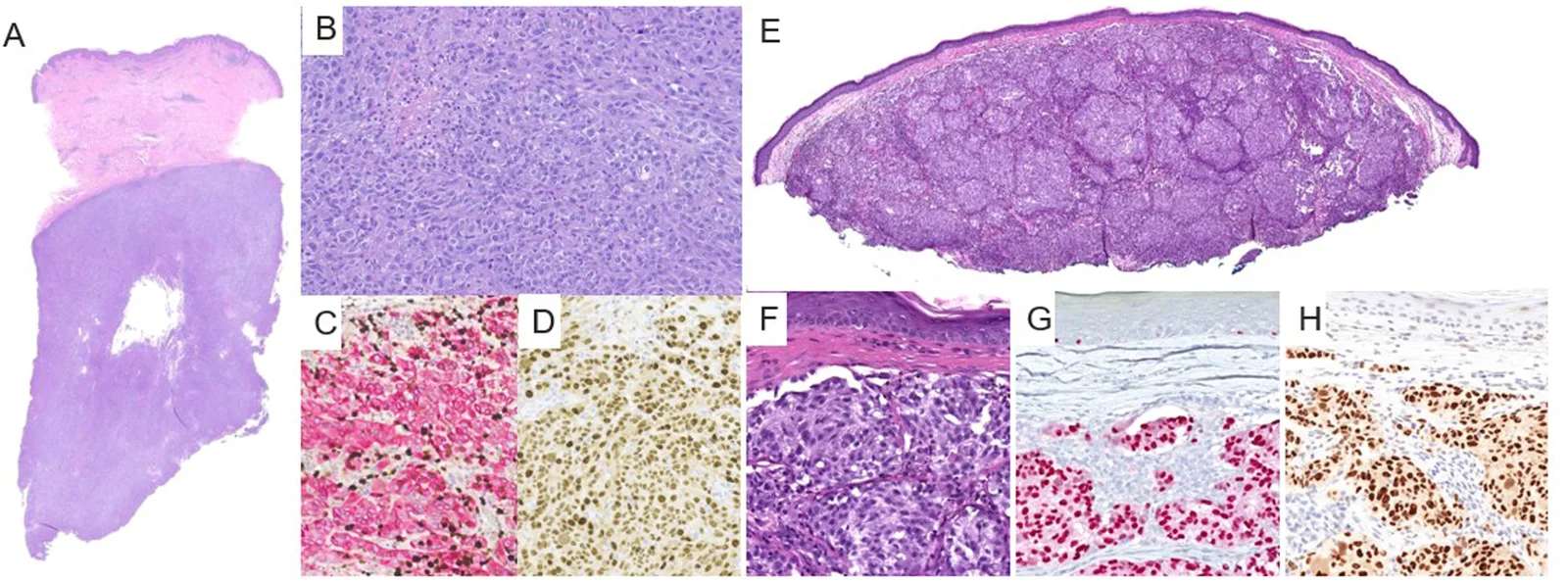
- MSK (Busam et al.) reviewed referred cases of metastatic melanoma with unknown primary (MUP) profiled by MSK-IMPACT; 19 met criteria for primary dermal melanoma (PDM) — dermal/subcutaneous origin without epidermal involvement, easily confused with cutaneous metastatic melanoma (CMM).
- PDM had a lower overall burden of genomic alterations; most frequently altered genes were TERT (79%), TP53 (37%), NRAS (37%) and APC (32%); more NRAS/TP53 and fewer BRAF alterations than CMM; exclusive ZFHX3, FGFR3, NTRK3, SMARCA4 mutations.
- PDM had superior overall survival compared with CMM (follow-up 8.9 years) and more favourable survival than conventional primary melanoma, supporting recognition as a separate entity for staging and treatment.
Scope: PubMed abstract only, plus the figure plate attached to the official Human Pathology X post. The article is subscription-only (Unpaywall: closed) and ScienceDirect returned a Cloudflare challenge, so full text, tables and figure legends were not collected.
Abstract
Primary dermal melanoma (PDM) is a rare type of melanoma that originates in the dermis or subcutis without epidermal involvement. PDM poses significant diagnostic challenges for accurate staging, because it may be confused with cutaneous metastatic melanoma (CMM). To assess potential misclassification of PDM, we retrospectively reviewed referred cases of metastatic melanoma with unknown primary (MUP) that underwent concurrent molecular profiling using the MSK-IMPACT platform. Nineteen cases meeting criteria for PDM were identified and exhibited a lower overall burden of genomic alterations, and a superior overall survival compared with CMM, supporting their reclassification as primary neoplasms rather than metastatic lesions. In PDM, the most frequently altered genes were TERT (79%), TP53 (37%), NRAS (37%), and APC (32%). Exclusive mutations identified in PDM included ZFHX3, FGFR3, NTRK3, and SMARCA4. Compared with CMM, PDM demonstrated a distinct mutational profile, characterized by a higher frequency of NRAS and TP53 mutations, and a lower prevalence of BRAF alterations. Clinically, PDM exhibited a more favorable overall survival (follow-up: 8.9 years) relative to conventional primary melanoma, further supporting the distinction from metastatic disease. Patients harboring isolated NRAS or concurrent NRAS/TP53 mutations exhibited superior survival compared with their respective NRAS wild-type or NRAS/TP53 wild-type counterparts. Taken together, these findings highlight the genomic and clinical distinctiveness of PDM relative to CMM, refine its molecular characterization, and support its recognition as a separate entity with implications for accurate staging and therapeutic decision-making.
Figure